Introduction: Part 1 of 3
I vividly remember the day my mother found out that her aunt had died.
She was in the upstairs hallway of our house—right outside my bedroom door—when she received a text message. She looked at her phone for a moment before shouting, “Praise the Lord!” Then she burst into tears. My dad came and held her while she sobbed.
I felt awkward… unsure what to do. My three younger siblings crowded into the doorways of their rooms, peering out at my mom with wide eyes; we rarely saw our parents cry. It took a minute for her to speak through the tears, and when she could she told us that our Aunt Roz had died.
I was confused. My mom’s crying made sense to me; I had sobbed uncontrollably when my grandparents’ cats died a few years prior. I knew what death was; it was worth crying about. But why did she first respond by praising God?
This article is going to talk about death and the process of dying. These topics are typically a little uncomfortable, partly because they are often not discussed until someone close to us is actually dying. At that point, emotions start getting involved and they can be intense.
Death was NOT part of God’s initial creation and is truly tragic.
Emotions (especially related to death) are NOT bad. Death was NOT part of God’s initial creation and is truly tragic. Death made even Jesus weep (John 11:35). However, since weeping makes it temporarily harder to think, I am hoping that for some readers this chapter comes before you have to face the death of someone close to you. I am hoping this discussion helps prepare your mind. When your mind has already processed an idea, it allows your heart more room to grieve.1, 2 We can’t dull the sharp pain of death, but the more we understand about the process the less power it will have.
2 Grieve: Verb. To let yourself experience a deep sadness when you lose something or someone you loved.
1 You are going to see lots footnotes on this page (and also throughout this entire website). Some of them will prevent me from plagiarizing by telling you who I am quoting (including the book, author, and page number – you will have to scroll to the very bottom of this page to see those footnotes, below the comment section), others will give you definitions for words that aren’t very common outside of church these days (these will be put in bold font), and still others will provide witty or helpful notes. If you want to read more about any particular idea, the book(s) mentioned in these footnotes are a good place to start!
For all readers (myself included), thinking about death is difficult but wise; it is impossible to live well if we don’t consider death. The Psalms say that death teaches us to “number our days” so that our hearts can grow in wisdom (Ps 90:12). When we consider that “our lives are limited [and] our days are numbered,” we are able to live our lives with urgency.3 We realize that life is too short to waste time.4
3 Urgency: Noun. A situation that requires or demands quick or swift action.
When is the last time death came up in a conversation you had? Why do you think it is so rarely talked about?
What is Death, and Where did It Come From?
We all have a rough idea of what death is. The lungs stop breathing, the heart stops beating, the body stops moving, and the brain stops thinking. Then the body begins to decay, withering away like worms on a sidewalk, moldy bread, or rancid meat.
It only takes an average of 20 years for human bodies—including the bones—to decompose. Corpses do last a little longer if they are embalmed. To embalm a body, all of the blood is pumped out and formaldehyde5 is pumped in to replace it, filling the arteries, veins, and capillaries;6 flooding the heart. Embalmed bodies can take a century to dissolve, but they are never again alive.
5 Formaldehyde: Noun. A chemical that helps preserve bodies.
6 Capillaries: Noun. Tiny blood vessels.
The death of humans is more than unpleasant; it’s unnatural. We know intrinsically7 that it wasn’t supposed to happen to us, our parents, or our friends. It feels more than wrong, even when it happens to pets.
7 Intrinsically: Adjective. To know something naturally without needing to think about it, or to be naturally part of something.
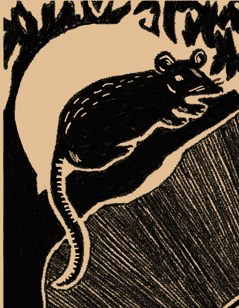
My two pet rats, Frisby and Nimh, died this past year (yes, I said pet rats). I was crushed. They were my little buddies, always excited to see me, eager to be held and to explore the wide world—of my bedroom—and eat all of the snacks they could convince me to give them. Then their little lungs got infected with bacteria—a common sickness in rats—and filled up with fluid.
Rats only live to be around 2 years old, so it wasn’t surprising that they got sick as they aged, but that didn’t make it less sad. Nimh died first, drowning in her own lungs, gasping for a breath she couldn’t take. Frisby lived longer thanks to antibiotics, but nine months later was struggling to breathe and the medicine was no longer working. I took her to the vet, and the vet gave her a lethal8 dose of medication that first put her into a deep sleep, and then stopped her heart.
8 Lethal: Adjective. To be deadly, or to cause death.
After both deaths, I cried with my best friend when I got home. We buried both of them in the garden, and prayed a liturgy9 over them through our tears. The liturgy was raw, and helped us express deep emotion while bringing the hurt to God:
9 Liturgy: Noun. A written prayer, used to guide private or group prayer.
“Our hearts are unprepared for such loss, and we are deeply grieved… O Lord, how long till all is made right? How long till your wild grace restores10 all loss and upends11 every leaving?”
– Every Moment Holy12
10 Restore: Verb. To bring something back to its original state; to fix or repair something that is broken.
11 Upend: Verb. To do the opposite of what is expected; to turn something upside down.
We could pray this prayer because death isn’t right. It literally wasn’t supposed to happen.
At the beginning of human history, God created Adam and Eve, and there was no death. It was only because Adam rebelled against God that death came (see Genesis chapter 3 for the full story).

The effects of Adam’s failure touch everything: our bodies, our relationships, our pets, our ecosystems, and our world.13 Romans 8 says that because of sin,14 “all of creation is groaning” with pain like a woman has when she is giving birth (Rom 8:22).
14 Sin: Noun. To intentionally or uncaringly rebel against God’s law; to miss the target in archery.
If humans weren’t created to die, what was supposed to happen?
God initially created us for life, eternal life with Himself in a perfect world. Thankfully, through Jesus there is hope that God will restore everything, both humans and “all of creation” (Rom 8:22).
It isn’t a flimsy hope either, like hoping we’ll win the lottery or that our favorite team will win the playoffs. This is a solid hope, like the hope I had as a middle schooler after my parents took me to a bike shop in December to pick out a much-wanted bike. When we got home, they hid the bike until Christmas day. My hope as I waited until Christmas was a certain hope; I was longing15 for the future when the joy of riding my bike would be complete. Our hope in God making all things right is like that: certain, solid, and expectant.16 With every earthly sorrow, the anticipation builds.
15 Longing: Verb. To deeply desire; to want very badly.
16 Expectant: Adjective. To expect something to happen.
When I was a middle school student I believed in Jesus and hoped for heaven; I’m older now and have experienced more sorrow than my middle-school self knew, and my hope has only gotten stronger. My longing for a future joy can increase because I am certain death won’t win in the end.
When you think of God making all things right, what are you most excited for Him to fix?
Does the thought of dying worry you? Why or why not?
>This isn’t the end! Stay Tuned for Death & Dying Part 2<
Footnotes to Prevent Plagiarism:
- 4 Dunlop, John T, “Death and Dying” Pages 34-43 in Dignity and Dying: A Christian Appraisal, edited by John F. Kilner, Arlene B. Miller, and Edmund D. Pellegrino (Grand Rapids, MI: William B. Eerdmans Publishing Co., 1996), 36.
- 12 McKelvey, Douglas Kaine, Every Moment Holy Volume 1: New liturgies for daily life (Nashville, TN: Rabbit Room Press, 2020), 210-211.
- 13 Wolters, Albert M., Creation Regained: Biblical Basics for a Reformational Worldview (Grand Rapids, MI: William B. Eerdmans Publishing Co., 2005), 53.
 Footnotes with Ray
Leave a comment